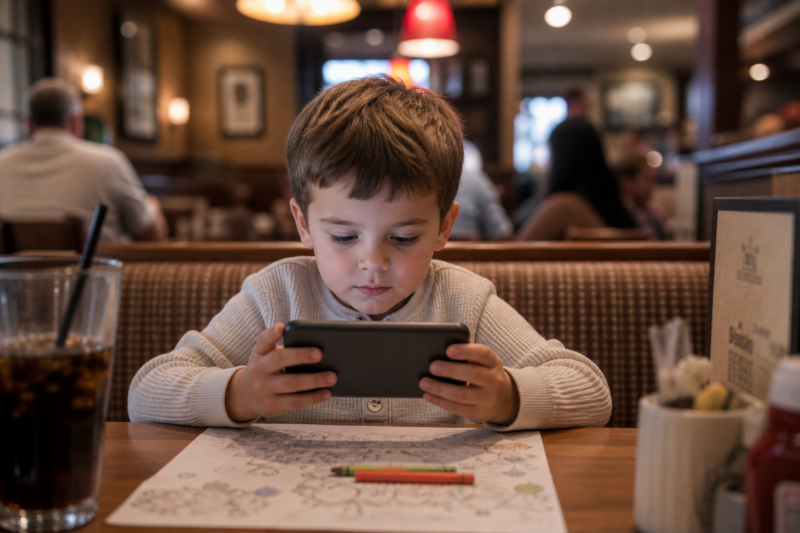
You’re sitting there, maybe waiting for your food or halfway through your meal, and you glance over at another table. There’s a child sitting quietly, watching something on a phone or tablet. No noise, no disruption, just calm. And yet somehow, that’s the exact moment people choose to form an opinion.
A look, a comment, sometimes even something said out loud. In that brief interaction, a whole story gets created about that parent. People assume they should be interacting more, that they’re taking the easy option, that this is what their parenting looks like all the time. But what’s being judged in that moment isn’t a full picture. It’s a tiny fragment of a much bigger day, and it’s being treated as if it tells you everything you need to know.
And what often gets missed is everything that came before that restaurant.
That same family might have spent the entire day at the beach. The kind of day that looks lovely from the outside, the kind people picture when they talk about making memories. But real life doesn’t unfold in those perfect, filtered moments. It looks like constantly watching the shoreline because your child doesn’t understand danger. It looks like running after them again and again when they head too close to the water. It looks like managing tiredness, hunger, sensory overwhelm, and transitions, all while trying to keep the day enjoyable. It’s full-on, relentless parenting where you don’t really get to switch off.
And still, they stayed. They played. They did everything people say parents should be doing.
By the time they walk into a restaurant, they’re not just ready for dinner. They’re physically and mentally drained. The adrenaline of the day has worn off, the hunger kicks in properly, and all they want is to sit down and eat a hot meal without having to manage every second of someone else’s needs.
So they hand over a phone.
I remember a parent telling me about a moment like this a few years ago, and it’s stayed with me ever since. She had spent the whole day at the beach with her autistic child. It had been a good day, but it had also been exhausting in a way that only parents of high support needs children really understand. There had been constant monitoring, running, redirecting, and holding everything together to keep her child safe and regulated.
That evening, they went to a restaurant. She sat down, completely drained, and gave her child a phone so she could eat. As she did, a man walked past her table and told her she needed to be a better mum. He said he had raised his children “properly,” and she should do the same.
She didn’t argue back. She didn’t explain. She just cried.
Not because she agreed with him, but because she had nothing left in her to defend herself. After a full day of giving everything to her child, she didn’t have the energy to justify that to a stranger who had seen less than a minute of her life.
That’s the part people don’t see.
Restaurants aren’t designed with children in mind. They rely on sitting still, waiting, being quiet, and following social expectations that don’t come naturally to many children, especially younger ones or those who are neurodivergent. So parents adapt. They bring things to help their child stay occupied and regulated, whether that’s a colouring book, a toy, or a screen.
Somewhere along the way, we decided that one of those tools is acceptable and another isn’t. A child drawing on paper is seen as wholesome and appropriate, but a child doing something similar on a screen is criticised, even if the outcome is exactly the same. A calm, settled child at the table should be the goal, yet the method used to achieve that is what gets judged. And if we’re honest, part of where that judgement comes from is something deeper than just opinions about screens.
A lot of people who speak the loudest about this are remembering their own experiences. They remember restaurants being hard. They remember constantly telling their children to sit still, be quiet, stop touching things. They remember not enjoying those moments, not being able to relax, not being able to just sit and eat.
And instead of looking at parents now and thinking, “I wish I’d had that option, that would have made things easier,” there can be this sense that if it was hard for them, it should be hard for everyone else too. Almost like it’s some kind of rite of passage that parents are supposed to go through.
But parenting doesn’t need to be unnecessarily difficult to be valid.
Struggle isn’t what makes someone a good parent.
If there is something available that makes a moment easier, calmer, and more manageable for both the child and the adult, there’s no reason not to use it. We don’t apply that logic to any other part of life. We don’t avoid helpful tools just because previous generations didn’t have access to them.
What’s actually happening in that moment isn’t laziness or a lack of effort. It’s a parent making a decision based on where they are at the end of a long day. It’s about keeping things manageable, preventing overwhelm, and making sure everyone gets through the experience without it turning into something stressful.
The alternative isn’t some ideal version of connection where everyone sits happily chatting. For many families, the alternative looks like constant correction, repeated instructions, and rising frustration on both sides. That isn’t a better experience for the child or the parent.
The reality is, you don’t know what happened before that restaurant. You don’t know how much that parent has already done that day, how much energy they’ve already used, or what their child needs in that moment. All you’re seeing is the end of a very long day, and making a judgement based on that alone misses everything that actually matters.
Sometimes, giving a child a phone at the table isn’t about disengaging or taking the easy option. It’s about getting through the moment in a way that works for everyone involved.
And for many parents, that isn’t just acceptable.
It’s necessary.
Add comment
Comments